
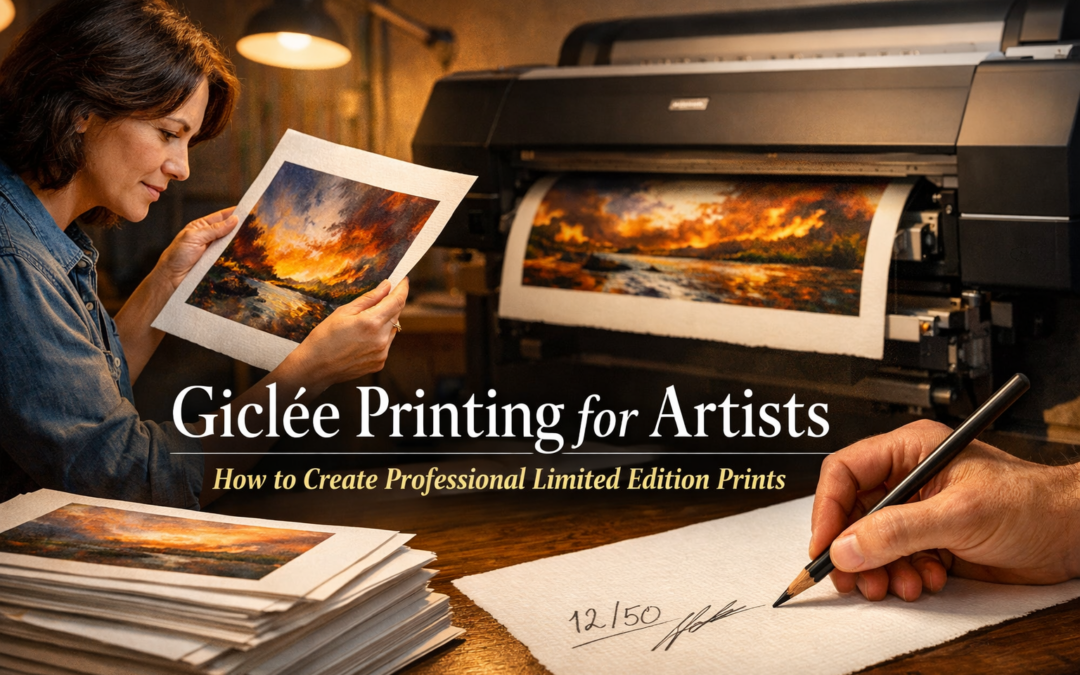
Giclee printing has transformed how artists share and sell their work. Where once the creation of a professional limited edition run required specialist lithographic studios and minimum print quantities in the hundreds, giclee printing allows any artist to produce a single print or a small signed edition with museum-grade archival quality. If you are an artist considering limited edition prints for the first time, this guide covers everything you need to know: from planning your edition to signing conventions, certificates of authenticity, paper choice, and how to price your work.
Why Giclee Printing Is the Right Choice for Artist Editions
The fine art market and major galleries recognise giclee prints as legitimate collectible works. Here is why professional artists choose giclee for their editions.
Archival Longevity
True Colour Fidelity
Market Acceptance
Planning Your Edition
Limited Edition vs Open Edition
A limited edition is a defined closed run of prints, after which no further copies are produced from that file or edition. The total count is declared upfront and each print is individually numbered. A open edition has no declared cap and may be reprinted on demand.
For collectors, limited editions carry greater scarcity value. Most artists selling through galleries or online platforms who wish to build collector relationships opt for limited editions. Open editions work well for lower price-point prints intended for a broader audience.
Practical Edition Sizes
There is no single correct edition size. Common ranges are:
- 10 or under — Highly exclusive. Suits large-format or highly priced work.
- 25 — A popular choice for emerging artists building early collector relationships.
- 50 — Balances scarcity with commercial reach. Widely used by mid-career artists.
- 100 to 150 — Suitable for artists with established audiences or gallery representation.
- 250 to 500 — Appropriate for open-market commercial prints where broad accessibility is the goal.
A smaller edition justified by higher pricing is often more commercially viable than a large edition priced cheaply.
Signing and Numbering Your Prints
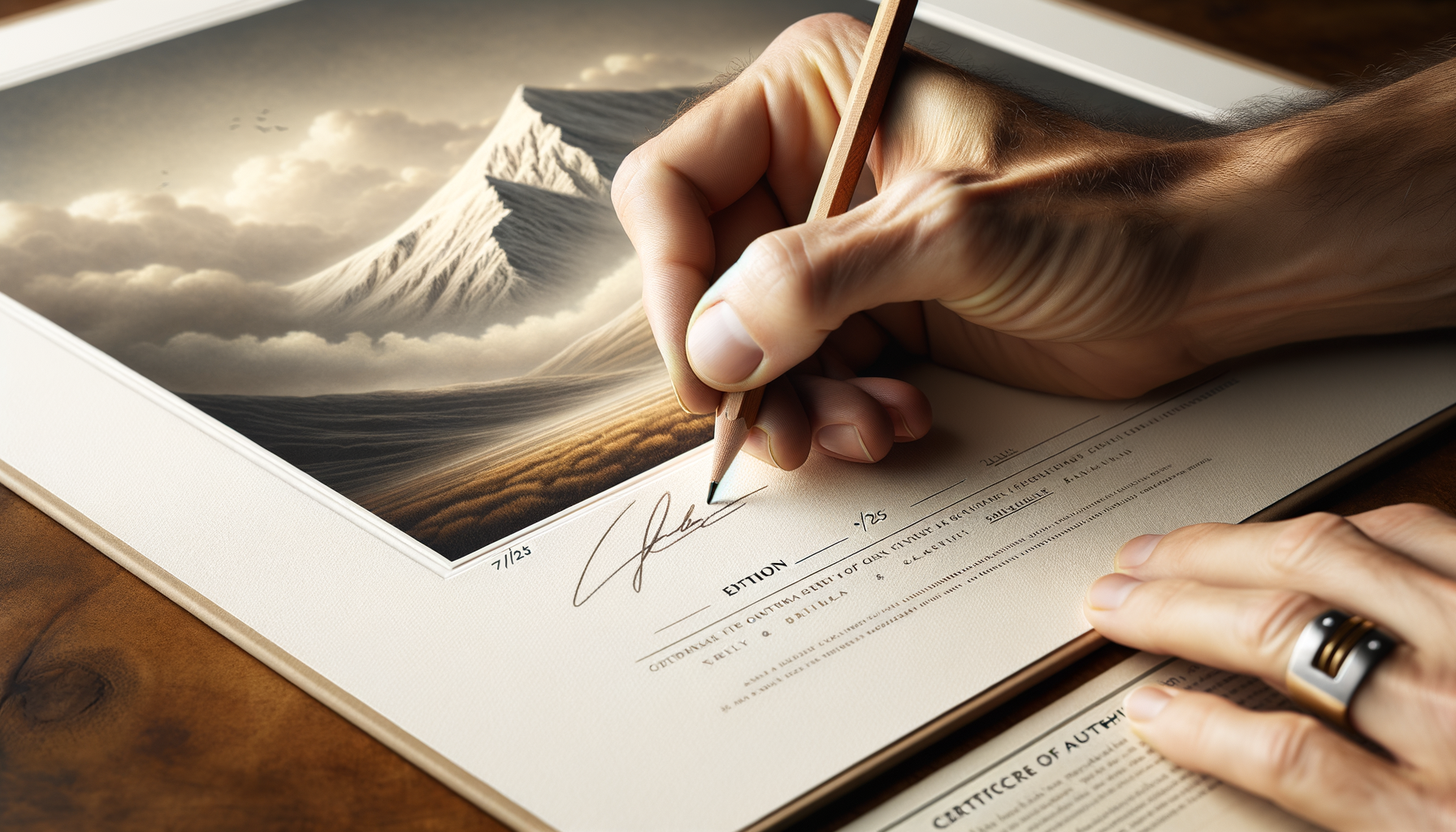
Hand-signing and numbering each print in pencil is the accepted convention in the giclee fine art market. Pencil is preferred because it cannot be reproduced in printing, providing a verifiable mark of authenticity.
Standard Numbering Conventions
- 3/25 — Third print of an edition of 25. Written in pencil on the lower left margin.
- AP 1/5 — Artist Proof. A small number held outside the main edition, typically 10% of the run or 5 copies, whichever is smaller.
- PP 1/2 — Printer Proof. Copies held by the printing studio for quality reference.
- HC 1/3 — Hors de Commerce (not for sale). Presentation copies for press or gallery use.
Artist Proofs often sell for a small premium as they are understood to precede the main edition. Never issue more Artist Proofs than the declared percentage, as this will undermine collector trust.
Certificates of Authenticity
A Certificate of Authenticity (CoA) is a printed document issued with each print that confirms the work’s provenance and edition status. It is not a legal requirement, but it significantly increases buyer confidence and resale value, and is expected by any serious collector or gallery.
A standard CoA should include:
- Title of the work
- Year of the original artwork and the print edition
- Medium (e.g., Giclee print on Hahnemuhle Photo Rag 308gsm)
- Print dimensions (image size and paper size)
- Edition number and total edition size (e.g., 12/50)
- Artist name and hand signature
- Studio or printer name confirming the production standard
- A statement of archival quality and expected longevity
- A unique serial or certificate number (for larger editions)
Keep a signed copy of the CoA in your own records alongside the file used to produce the edition. If a collector ever needs to verify provenance, a matching record from both artist and printer is the strongest possible documentation.
Choosing the Right Paper for Your Edition
Paper choice defines the character of your print as much as the image itself. Each substrate brings its own texture, finish, and tonal response. The right choice depends on your subject matter, the collectors you are reaching, and how the work will typically be displayed.
Fine Art Cotton Rag
Baryta Photo Paper
Giclee Canvas
Preparing Your Files for Giclee Printing
The quality of your giclee print is determined largely by the quality of the source file. As a minimum, work to the following standards:
- Resolution: 300 dpi at final print size. For large-format prints viewed at distance, 200 dpi at output size can produce excellent results.
- Colour space: Submit files in Adobe RGB (1998) for the widest gamut, or sRGB if your workflow is screen-based. Do not submit CMYK files.
- File format: TIFF (lossless) is strongly preferred. High-quality JPEG at maximum quality is acceptable for most purposes. Avoid repeatedly saving and re-saving JPEG files.
- Scanning originals: Use a professional flatbed at a minimum of 400 dpi optical. For large original paintings, a high-resolution copy stand under gallery lighting is more appropriate than a flatbed scanner.
For a comprehensive technical walkthrough, see our guide on how to prepare your artwork files for giclée printing.
Pricing Your Limited Edition Giclee Prints
Pricing limited edition prints is one of the areas artists find most challenging. There is no universal formula, but a consistent and defensible approach builds collector trust over time.
Factors that influence print price
- Cost of production — Printing costs, framing or mounting if applicable, CoA printing, packaging, and shipping must be covered as a floor.
- Edition size — A print from an edition of 10 commands a higher price than the same image from an edition of 100. Scarcity has direct market value.
- Original artwork value — Prints are generally priced at 10% to 20% of the value of the original painting. This creates a clear and justified hierarchy.
- Artist profile — Gallery-represented artists, award-holders, and artists with an established sales history can command higher prices than emerging artists building their audience.
- Print size and paper — Larger prints on premium cotton rag or specialist substrates carry higher material costs and command higher prices.
- Progressive pricing — Many artists price the first 10% of an edition at a lower release price, increasing the price as the edition sells. This rewards early collectors and creates urgency.
A simple starting point: Add together your print cost, packaging, and time. Multiply by three to cover overheads and margin. Then compare against the prices of comparable artists at a similar career stage in your market. Adjust accordingly, and stick to your pricing consistently once set.
Start Your Edition with Giclée London
Giclée London has been producing artist editions for over 40 years. We use professional Canon imagePROGRAF presses with archival pigment inks and a curated range of fine art papers including cotton rag, baryta, lustre, and canvas. Every print is ICC-profiled and quality-checked before dispatch.
Our online designer makes it easy to upload your artwork, choose your paper and size, specify border dimensions, and see live pricing instantly. Orders are dispatched across the UK from our studio in Wokingham, Berkshire. We can also advise on paper selection and optimal file preparation before you order.
Questions about starting your edition? Contact us at sales@gicleelondon.co.uk or call 020 8898 1987.
Frequently Asked Questions
Can I produce a limited edition from an existing digital painting or photograph?
Yes. The source of the image does not affect the legitimacy of the edition. Whether your work is a digital painting, a photograph, a scan of a traditional painting, or a mixed-media piece, giclee printing produces an archival output that can be signed and numbered as a limited edition.
How do I know how many prints to include in my edition?
Consider your current audience size and sales velocity. An edition of 25 is a practical starting point for an emerging artist with an engaged but modest following. If the edition sells through quickly, resist the temptation to reopen it. That discipline is what maintains the value of your editions over time.
Are giclee prints accepted in fine art galleries?
Yes. Giclee prints are exhibited and sold in major galleries and are listed and sold at major auction houses including Christie’s, Sotheby’s, and Phillips. The key requirements are that the print is produced on archival materials, the edition is declared, and the work is signed and accompanied by a Certificate of Authenticity.
What happens to the digital file once an edition is closed?
By convention, the master file used to produce a closed edition should not be used to produce further prints in the same size and on the same substrate. You may produce a new edition on a completely different substrate (e.g., a paper edition followed by a separate canvas edition), providing this is declared and the two editions are differentiated clearly in your documentation and any certificates issued.
Do giclee prints need to be framed under UV glass?
UV-filtering glazing significantly extends the display life of any print and is worth recommending to buyers. Without UV protection, direct sunlight will accelerate fading in even the most archival prints. For long-term preservation, a combination of UV glass, acid-free mount board, and indirect lighting is the best arrangement.