
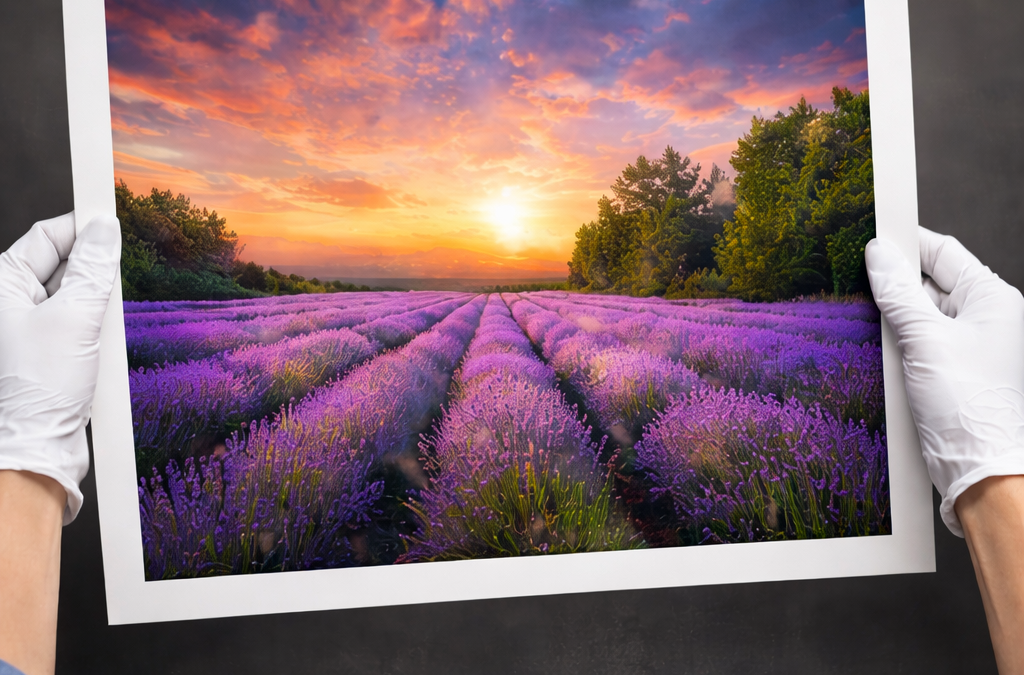
Giclee printing is widely regarded as the gold standard for fine art reproduction. Whether you are an artist wanting museum-quality prints of your original work, a photographer seeking archival reproductions, or a collector investing in limited edition prints, understanding giclee printing helps you make informed decisions about the quality and longevity of what you are buying or commissioning.
What Is Giclee Printing?
The term giclee (pronounced zhee-KLAY) comes from the French word meaning “to spray.” Giclee printing is a process in which high-resolution digital images are rendered onto archival substrates using professional-grade inkjet printers loaded with pigment-based inks. The result is a print with exceptional tonal range, colour accuracy, and longevity that far exceeds conventional offset or photographic printing methods.
Modern giclee presses, such as those in the Canon imagePROGRAF and Epson SureColor ranges, deploy between 8 and 12 individual ink channels. This allows for precise colour mixing across a wide gamut and the gradual transitions of tone that make giclee prints virtually indistinguishable from original paintings or classic darkroom photographs.
How Giclee Printing Works
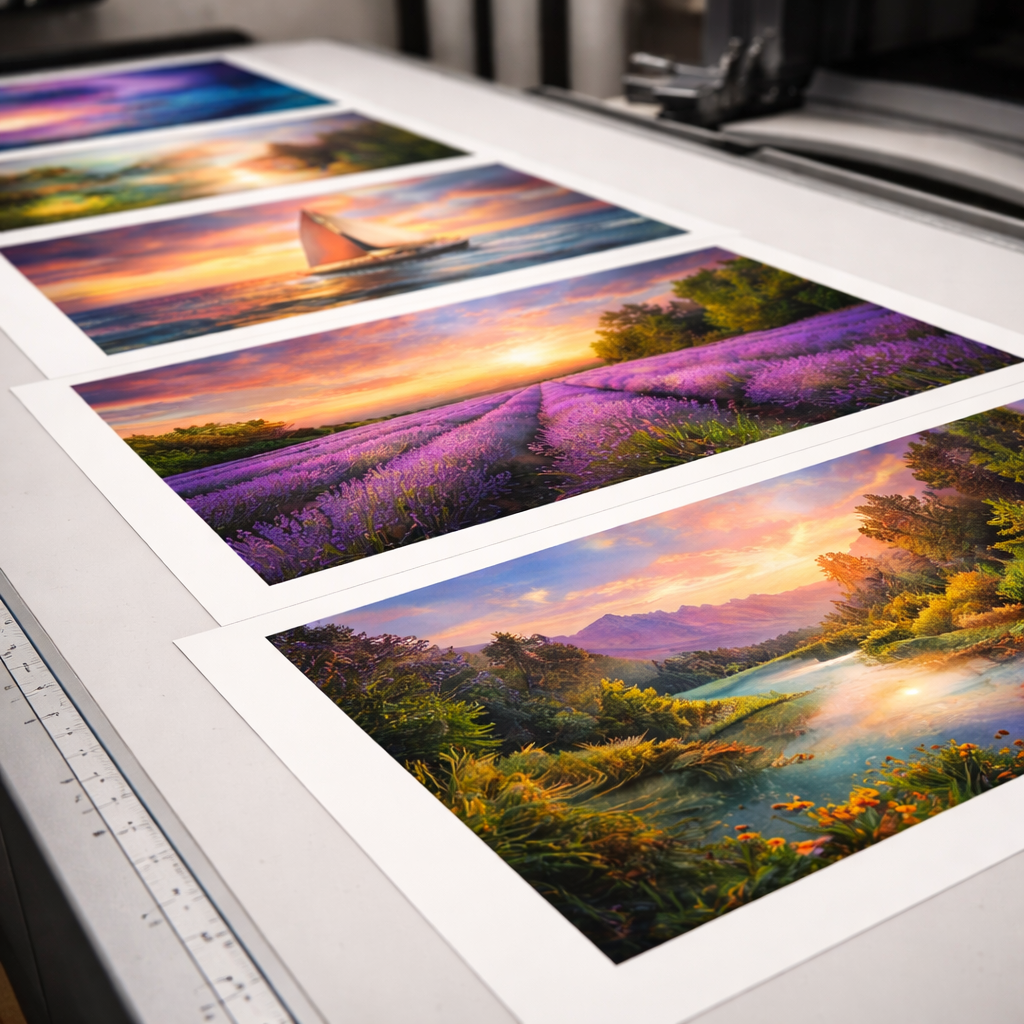
The giclee printing process begins long before ink touches paper. A high-resolution scan or digital file of the artwork is colour-profiled and calibrated against the specific paper or canvas being used. This colour management step is critical. Without it, even the finest printer will produce output that misrepresents the original.
- Resolution: Giclee files are typically prepared at 300 to 400 dpi at print size. For very large prints, 150 to 200 dpi at final output size can still produce excellent results.
- Colour profiles: ICC profiles are applied to match the printer, ink set, and paper combination. This ensures colours appear as intended across different viewing conditions.
- Substrate selection: Archival papers, cotton rag papers, baryta photo papers, and canvas are all common substrates. Each responds differently to ink and gives a distinct aesthetic and texture.
- Ink: Pigment inks are used rather than dye-based inks. Pigment particles are physically larger and sit on the paper surface rather than being absorbed, which significantly increases resistance to fading from UV light and atmospheric pollutants.
Giclee Printing vs Standard Inkjet Printing
The term inkjet printing covers an enormous range of quality, from budget home printers to professional fine art presses. Giclee printing sits firmly at the top of that range, but there are specific differences worth understanding:
| Feature | Giclee Printing | Standard Inkjet |
|---|---|---|
| Ink type | Archival pigment inks | Often dye-based |
| Colour channels | 8 to 12 | 4 to 6 |
| Longevity (light fastness) | 70 to 200+ years | 5 to 25 years |
| Paper range | Archival art papers, cotton rag, baryta, canvas | Typically coated photo papers |
| Colour accuracy | ICC profiled, calibrated output | Variable |
| Best suited for | Fine art, limited editions, photography | Everyday documents and photos |
What Can You Print with Giclee?
Giclee printing is suitable for a wide range of applications. Professional artists use it to produce limited edition runs from original paintings or drawings. Photographers rely on it to create gallery exhibition prints and archival portfolios. Businesses commission giclee reproductions of historical maps, technical illustrations, and heritage artwork. Interior designers specify it for large-format statement pieces where colour fidelity and surface quality must be maintained at scale.
Fine Art Reproductions
Photography Printing
Limited Editions
Choosing the Right Paper for Giclee Printing
Paper choice is one of the most consequential decisions in the giclee process. The substrate determines surface texture, colour response, perceived weight, and how the print will age over time. Below are the most widely used categories:
Cotton Rag and Mould-Made Papers
Papers such as Hahnemuhle Photo Rag, Canson Platine, and Fabriano Artistico contain a high percentage of cotton fibre rather than wood pulp. Cotton papers are acid-free and lignin-free by nature, giving them neutrality that prevents yellowing over time. The surface texture of cotton rag papers can range from a smooth hot-press finish to a more textured cold-press or rough surface, making them popular for reproducing paintings and detailed drawings.
Baryta Papers
Baryta papers replicate the look and feel of traditional fibre-based darkroom photographic papers. They have a semi-gloss or pearl surface that gives deep blacks and smooth tonal gradation. They are a preferred choice among photographers seeking a classic look combined with the advantages of digital output and pigment ink longevity.
Canvas
Giclee printing on canvas is popular for oil painting reproductions and large decorative prints. Canvas can be stretched onto wooden frames to create a gallery wrap effect, or left flat for framing. Coating quality varies between canvas products, so it is important to choose an archival-grade coated canvas to ensure ink adhesion and longevity.
How Long Do Giclee Prints Last?
Longevity is one of the defining claims of giclee printing, but it requires some qualification. Wilhelm Imaging Research, the leading independent body for print permanence testing, tests prints under standardised indoor display conditions (approximately 450 lux, 12 hours per day). Under these conditions, prints produced with top-tier pigment inks on archival cotton rag papers consistently test at 100 to 200 years or more before visible fading occurs.
In practice, longevity depends on a combination of factors: the ink set and printer used, the quality and archival rating of the paper, how the print is displayed (direct sunlight will dramatically shorten its life), and whether it is glazed with UV-protective glass when framed. A giclee print displayed in indirect light under UV glass can be expected to retain its colours for multiple generations.
“Giclee printing with archival pigment inks and cotton rag papers consistently achieves light fastness ratings of 100 years and above under standard indoor display conditions, making it the most durable form of digital print available today.”
Wilhelm Imaging Research
Preparing Your Artwork for Giclee Printing
Getting the most from giclee printing starts with your source file. The quality of the print can only ever be as good as the quality of the image going in. Here are the key technical requirements:
- File format: TIFF or high-quality JPEG at print size. Avoid upsampling small files to meet size requirements.
- Resolution: 300 dpi at final print size is the standard for giclee printing. Files at 200 dpi can still produce excellent results for large-format prints viewed from distance.
- Colour space: Submit files in Adobe RGB (1998) for the widest colour gamut, or sRGB if your workflow is web-based. Avoid CMYK for giclee printing as it is an RGB output process.
- Scanning originals: Use a professional flatbed scanner or a high-resolution copy stand to capture originals. Drum-scanning services are available for the highest possible quality from physical originals.
- Soft proofing: If your software supports it, soft proof against the paper profile before submitting to see a simulation of the final output on screen.
What to Look for in a Giclee Printing Studio
What to look for
- Professional Epson or Canon large-format printer
- Archival pigment inks (not dye-based)
- ICC-profiled workflow for each paper
- Wide range of archival paper choices
- Colour management and proofing service
- Experience with fine art and photographic work
Questions to ask
- Which printer and ink set do you use?
- What are your Wilhelm light fastness ratings?
- Do you use ICC profiles for each paper?
- Can I see printed paper samples first?
- Do you offer colour matching to my original?
- What is your returns or reprint policy?
Giclee Printing at Giclée London
At Giclée London, we have been producing giclee prints for artists, photographers, galleries, and collectors since our founding. We use professional Canon imagePROGRAF presses with archival pigment inks on a curated selection of fine art papers including cotton rag, baryta, lustre, and canvas. Every print is produced using ICC-profiled colour management to ensure output that faithfully represents your original artwork.
We offer prints from a single copy up to large edition runs, with optional mounting, framing, and gallery-ready finishing. Our online designer tool makes it easy to upload your artwork, choose your paper and size, and see pricing instantly. Orders are dispatched across the UK from our studio in Wokingham, Berkshire.
Frequently Asked Questions about Giclee Printing
Is giclee printing the same as inkjet printing?
All giclee printing is inkjet printing, but not all inkjet printing is giclee printing. The term giclee specifically refers to high-resolution output produced on professional presses using archival pigment inks and fine art or photographic substrates. Consumer inkjet printers use lower-resolution print heads, fewer colour channels, and often dye-based inks that fade much more quickly.
How big can giclee prints be made?
Professional large-format giclee presses can print up to rolls of 44 or 60 inches wide, and virtually any length. The practical limit is usually the resolution of the source file rather than the printer itself. A high-resolution scan of an original painting can support very large print sizes without visible quality degradation.
Can giclee prints be signed and numbered?
Yes. One of the attractions of giclee printing for artists is that prints can be individually hand-signed and numbered just as traditional screen-print or lithograph editions are. This is accepted practice within the fine art market and galleries. Many artists produce giclee limited editions alongside their originals as a way of making their work accessible to a wider audience.
What is the difference between giclee on paper and giclee on canvas?
Giclee on paper uses archival fine art or photographic papers that are typically framed glazed. Giclee on canvas uses a coated artist canvas that can be stretched and displayed without glass, which is often preferred for oil painting reproductions. Paper tends to provide superior fine detail and colour depth. Canvas gives a more tactile, painterly appearance that suits certain subject matter and settings.